Pythagorean Theorem Calculator
Calculate the hypotenuse or either leg of any right triangle, find perimeter and angles, and verify square 90-degree framing layouts using the 3-4-5 rule.

How to Use the Pythagorean Theorem Calculator
Select whether you need to find the diagonal hypotenuse (c) or one of the perpendicular legs (a or b).
Enter side measurements in any consistent unit (feet, inches, centimeters, or meters).
Check the computed side length and verify if the triangle satisfies right-angle square layout criteria.
Apply the 3-4-5 rule (or multiples like 6-8-10, 9-12-15) to pull diagonals and square deck ledgers or foundations.
Formula & Calculation Logic
The Pythagorean Theorem states that in any right-angled triangle, the square of the hypotenuse (the side opposite the right angle) is equal to the sum of the squares of the two shorter legs. This geometric law forms the foundation of all framing, roof pitch calculations, and construction layout squaring.
Worked Example
Squaring a Deck Foundation with the 3-4-5 Rule
When building a rectangular deck, measure 6 feet along the house ledger board (side a) and 8 feet along the perpendicular rim joist (side b). Pull your tape measure across the diagonal between the two marks. If the diagonal measures exactly 10 feet, the corner is a true 90-degree right angle (6² + 8² = 36 + 64 = 100, and √100 = 10). If the diagonal is over 10 feet, the corner is obtuse; if under 10 feet, it is acute.
Visual Explanation Diagram
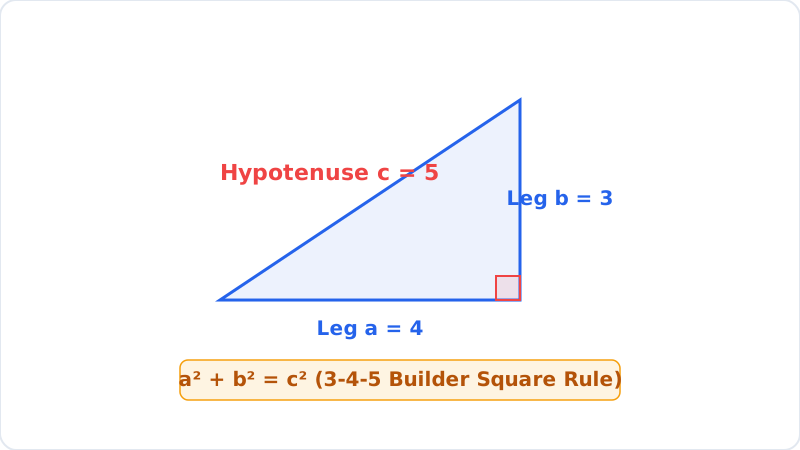
Right triangle with legs a and b and hypotenuse c
Frequently Asked Questions
Any triangle with side lengths in a 3:4:5 ratio forms a guaranteed 90-degree right angle. Builders measure 3 feet down one wall, 4 feet down the adjacent wall, and adjust the corner until the diagonal measures exactly 5 feet.
No, the classical theorem only applies to triangles containing a 90-degree angle. For oblique triangles (acute or obtuse), use the Law of Cosines: c² = a² + b² - 2ab·cos(C).
The longest side is always the hypotenuse, which sits directly opposite the 90-degree right angle.
Treat the half-span of the building as leg a, the roof rise (height) as leg b, and the hypotenuse c gives the exact theoretical line length of the common rafter before adding the tail overhang.
Common Pythagorean Theorem Calculations
This free Pythagorean theorem calculator solves every variation of the right triangle formula a² + b² = c². Whether you need to find the hypotenuse, solve for a missing leg, or work in feet and inches on a job site, the tool handles each case instantly.
- Find c (hypotenuse): enter both legs and the calculator returns the hypotenuse, c = √(a² + b²). This doubles as a quick hypotenuse calculator for diagonals and rafter lengths.
- Find a (missing leg): enter the hypotenuse and leg b to solve for the missing leg length, a = √(c² − b²).
- Find b (missing leg): enter the hypotenuse and leg a to find b = √(c² − a²).
- Feet and inches: convert inches to a decimal (divide by 12) and enter consistent units — the calculator works in feet, inches, meters, or centimeters.
- 3-4-5 squaring: verify a true 90° corner using the 3-4-5 rule and its multiples (6-8-10, 9-12-15) for framing, decks, and foundations.