Area Calculator
Quickly solve the two-dimensional surface area for common geometric shapes with instant conversions across square feet, square meters, square yards, and acres.

How to Use the Area Calculator
Choose between Rectangle, Triangle, Circle, or Trapezoid in the selector dropdown.
Input the required values such as radius for circles, or base and height for triangles.
Examine equivalent area outputs in square feet, square meters, square yards, and land acres.
Use these numbers for turf seeding, landscape mulching, or foundation estimates.
Formula & Calculation Logic
Area represents the amount of 2D space enclosed within a closed boundary. Rectangles multiply linear axes directly. Triangles represent half of a corresponding bounding rectangle. Circles use the mathematical constant Pi (approximately 3.14159) multiplied by the radius squared. Trapezoids average the two parallel bases before multiplying by the height.
Worked Example
Circular Fire Pit Patio Area Calculation
To install a circular paver patio with a radius of 7 feet from the center fire pit to the perimeter border: Area = π × r² = 3.14159 × 7² = 3.14159 × 49 = 153.94 square feet. Dividing 153.94 by 9 gives 17.1 square yards, helping you purchase the exact quantity of sand base and perimeter paver stones.
Visual Explanation Diagram
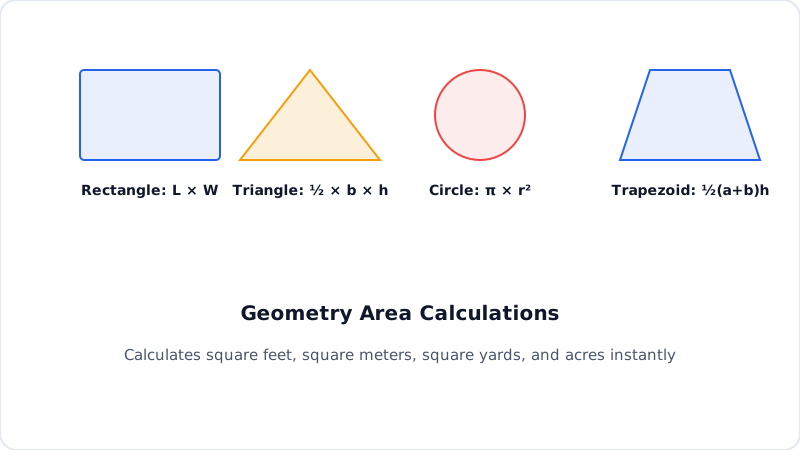
Four shapes with the area formula for each
Frequently Asked Questions
The radius is always exactly half of the diameter. If your circle measures 12 feet across from edge to edge through the center (diameter), the radius is 12 / 2 = 6 feet.
There are exactly 43,560 square feet in one acre. To convert any square foot area to acres, divide the total square feet by 43,560.
The area of an ellipse is Area = π × a × b, where a is the semi-major axis (half the longest diameter) and b is the semi-minor axis (half the shortest diameter).
Triangulate the polygon by drawing diagonals from one vertex to all non-adjacent vertices. Calculate the individual area of each triangle, then sum them together.