Cement & Concrete Calculator
Accurately convert slab, footing, and post hole dimensions into cubic yards and cubic feet, with exact premixed bag yields for 80 lb, 60 lb, and 40 lb bags.
How to Use the Cement & Concrete Calculator
Enter the length and width of your concrete form in feet. For odd inches, convert to decimal feet.
Standard residential sidewalks and patios are 4 inches thick; driveways are typically 5 to 6 inches.
Subgrade soil settles and wooden forms bulge slightly under wet hydrostatic concrete pressure.
If your project exceeds 1.5 to 2.0 cubic yards, ordering a ready-mix transit truck is usually cheaper and much faster than hand-mixing bags.
Formula & Calculation Logic
Concrete volume is always measured in cubic yards (27 cubic feet per cubic yard). Divide the depth in inches by 12 to convert to feet before multiplying with length and width. Ready-to-use concrete premix yield sheets specify that an 80 lb bag yields approximately 0.60 cubic feet, a 60 lb bag yields 0.45 cubic feet, and a 40 lb bag yields 0.30 cubic feet.
Worked Example
Backyard Patio Slab Pour Example
Pouring a 10 ft by 10 ft patio slab at 4 inches thick: Volume = 10 × 10 × (4 / 12) = 33.33 cubic feet. Dividing by 27 gives 1.23 cubic yards. Adding a 10% safety margin brings the total to 36.67 cubic feet (1.36 cubic yards). If using 80 lb Quikrete or Sakrete bags, you need 36.67 / 0.60 = 61.1, rounded up to 62 bags.
Visual Explanation Diagram
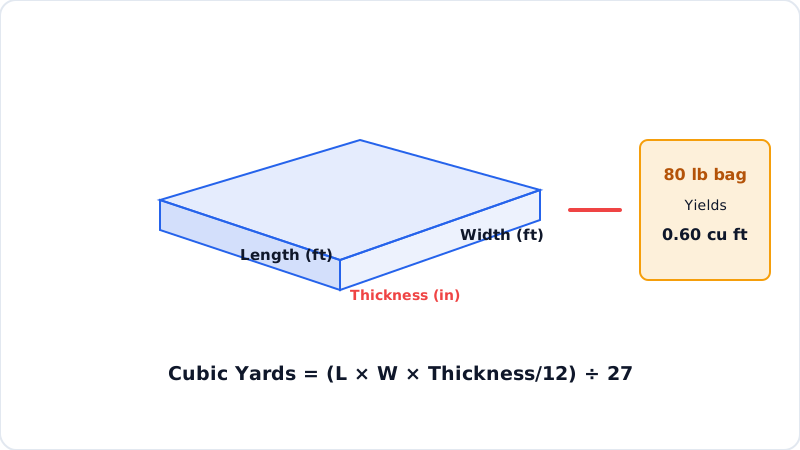
Concrete slab with length, width and depth used to work out the number of cement bags
Frequently Asked Questions
It takes 45 bags of 80 lb concrete mix to yield one cubic yard (27 cu ft / 0.60 cu ft per bag = 45 bags). For 60 lb bags, you need 60 bags per cubic yard (27 / 0.45 = 60).
When your pour exceeds 1 cubic yard (or approximately 45 to 50 bags). Hand-mixing 50 bags takes hours of heavy physical labor, whereas a ready-mix truck chute pours 1 to 5 yards in 15 minutes.
Standard residential walkways, patios, and shed pads should be 4 inches thick. Driveways supporting passenger vehicles should be at least 5 to 6 inches thick with rebar or wire mesh reinforcement.
Ground is rarely laser-flat; minor low spots of half an inch across a 100 sq ft slab will consume noticeable volume. Running out of concrete halfway through a pour creates an unsightly cold joint.
Common Concrete & Cement Calculations
This concrete calculator converts slab, footing, and post-hole dimensions into the exact volume and bag counts you need, so you can order the right amount of ready-mix the first time.
- Concrete in cubic yards: volume in cubic feet divided by 27 gives cubic yards — the unit ready-mix trucks are ordered in.
- Concrete by the square foot: enter the slab area and thickness and the calculator finds the cubic yards and total bags needed.
- Bag counts (40, 60, 80 lb): an 80 lb bag yields ~0.60 cu ft, a 60 lb bag ~0.45 cu ft, and a 40 lb bag ~0.30 cu ft — matching Quikrete and Sakrete premix yields.
- Slabs, footings, and post holes: works for patios, driveways, sidewalks, footings, and cylindrical post holes.
- Waste margin: add 5–10% extra to cover spillage, uneven subgrade, and over-excavation.