Options Payoff Calculator
Model options profit, loss, and breakeven at expiration across Long Call, Long Put, Covered Call, and Cash-Secured Put strategies.

How to Use the Options Payoff Calculator
Choose Long Call if you anticipate the underlying equity to rise, or Long Put if you anticipate a decline.
Enter the strike price and per-share market price (premium) paid to purchase the contract.
Remember that standard equity options control exactly 100 shares per 1 contract.
Adjust target expiration prices to identify your exact dollar breakeven and risk cutoff.
Formula & Calculation Logic
An option is a derivative contract granting the buyer the right, but not the obligation, to buy (call) or sell (put) an underlying stock at a set strike price on or before expiration. Breakeven occurs when the underlying stock moves past the strike price by an amount equal to the premium paid.
Worked Example
Long Call Bullish Equity Scenario Walkthrough
You buy 1 contract of XYZ stock with a $100.00 strike price for a $3.00/share premium ($300 total capital at risk). Breakeven is $100 + $3 = $103.00. If the stock trades at $115.00 at expiration: Intrinsic contract value is ($115 - $100) × 100 = $1,500. Deducting the initial $300 cost leaves a net profit of $1,200 (a 400% return on invested capital). If the stock finishes below $100, the contract expires worthless and your loss is capped at $300.
Visual Explanation Diagram
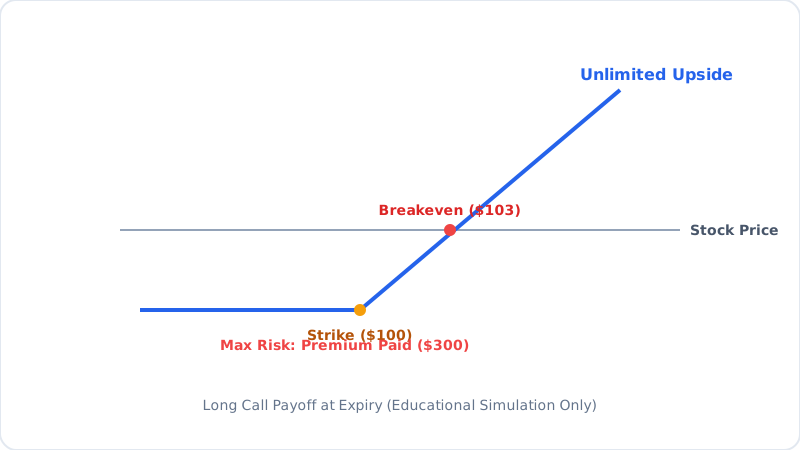
Payoff diagram of a long call option showing breakeven and profit above it
Frequently Asked Questions
When buying an option (long call or long put), your maximum loss is strictly limited to 100% of the initial premium paid to purchase the contract, regardless of how far the stock moves against you.
In US equity markets, one standard option contract controls exactly 100 shares of the underlying stock.
A call option is In the Money when the underlying stock price is above the strike price. A put option is In the Money when the stock price is below the strike price.
No. This tool is designed strictly for mathematical education and hypothetical modeling. Options trading carries substantial risk of loss and is not suitable for all investors.